
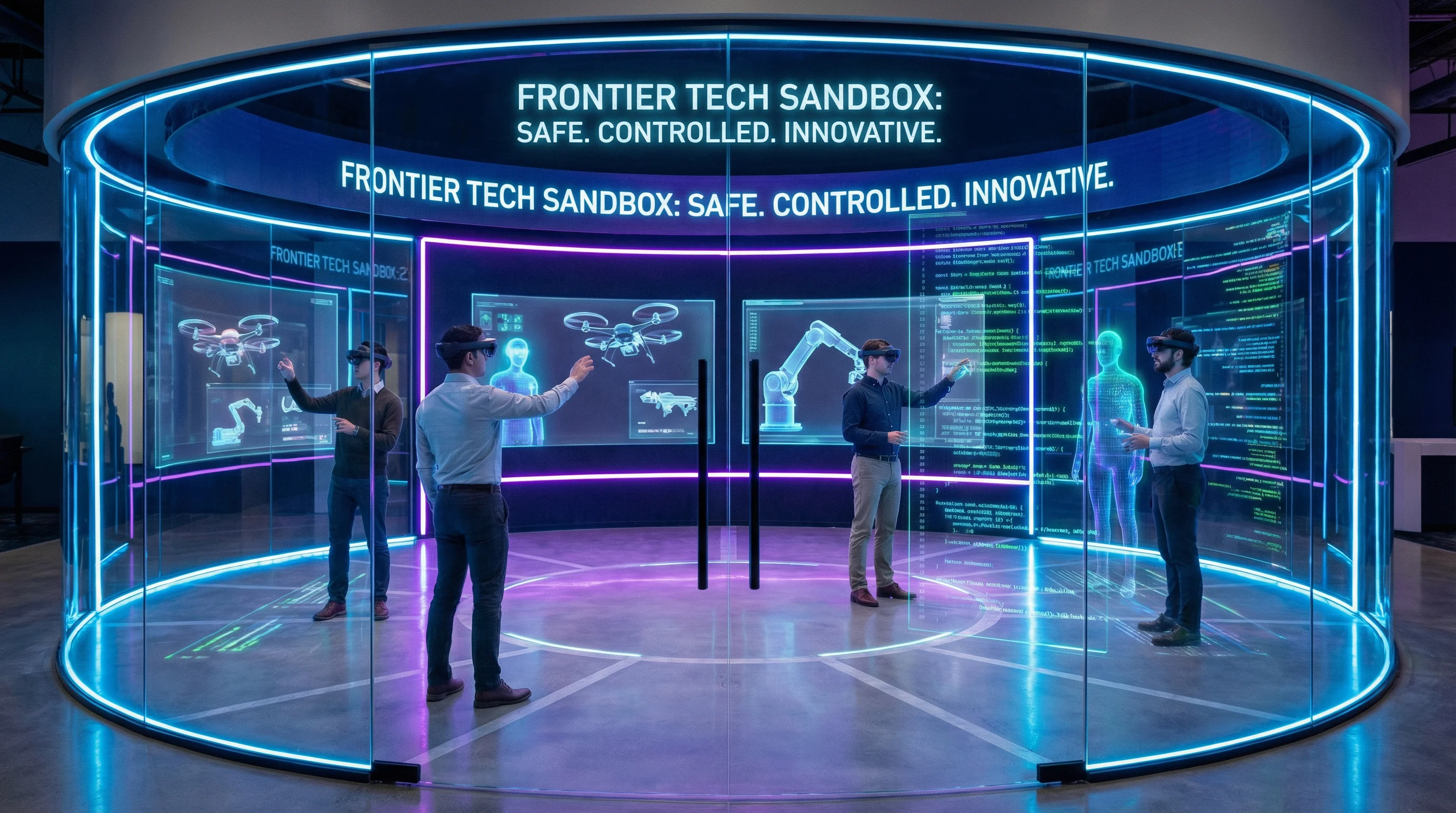
Project Overview
The Strategic Imperative
Pakistan currently ranks low on the UNCTAD Frontier Technologies Index, signaling a critical gap in readiness for the Fourth Industrial Revolution. This deficit is not due to a lack of talent, but a lack of accessible infrastructure. High capital barriers prevent local innovators from experimenting with cutting-edge hardware like Huawei 920C NPUs or industrial robotics.
The "Sandbox-as-a-Service" Model
This project democratizes access to elite infrastructure. By offering hourly, pay-as-you-go access to these sandboxes, we lower the barrier to entry from millions of dollars to just a few dollars per hour. This enables startups, researchers, and students to prototype, test, and validate world-class solutions without upfront CAPEX, directly catalyzing a rise in our global innovation ranking.
Investment & Impact Analysis
High PriorityFinancial Performance
Compute usage fees, Sandbox licensing, Certification services, IP commercialization
Phase 2: Ecosystem Expansion
Expansion into specialized domains including Renewable Energy, RWA Tokenization, Nano Technologies, and Advanced Manufacturing, unified by the central AI layer.
Economic Multipliers
- Democratized access to world-class compute for universities nationwide
- Creation of specialized innovation clusters (AgriTech, Robotics, Health, Cleantech)
Accelerates deployment of frontier tech solutions by 3x.
Key Objectives
Key Deliverables
- Ministry of IT & Telecom
- National Aerospace Science & Technology Park
- Ignite
- Private Tech Sector & Academia
- Public Sector Development Program
- International Tech Partnerships
- Artificial Intelligence
- Internet of Things
- Big Data
- Blockchain
- 5G
- Robotics
- Drone Technology
- 3D Printing
- Solar PV
- Concentrated Solar Power
- Wind Energy
- Biogas and Biomass
- Green Hydrogen
- Biofuels
- Electric Vehicles
- Nanotechnology
- Gene Editing
UNCTAD Frontier Tech Index Projection
Projected ranking improvement based on funding scenarios
+50 Positions Improvement
Funding: $25M/yr
Balanced investment enables steady infrastructure rollout and workforce certification, achieving regional competitiveness.
Note: Projections are based on UNCTAD methodology. Actual results depend on policy stability and global market conditions.
AI Infrastructure Cost Simulator
Compare the cost of owning Huawei 920C infrastructure vs. the Sandbox-as-a-Service model
Simulating a cluster of 1x Huawei 920C NPUs
14% utilization rate
Upfront Hardware Cost
$18,000
1st Year Total Cost
$20,700
Includes power, cooling & maintenance
Upfront Cost
$0
1st Year Total Cost
$1,920
Based on 100 hours/month usage
Total First Year Savings
Equivalent to funding 0 seed-stage startups
Hardware Efficiency Analysis
Comparative performance metrics: Sovereign NPU vs. Market Standard
The Huawei 920C delivers superior performance-per-watt, reducing long-term OPEX for the National AI Cloud.
National AI Infrastructure
The "Engine of Innovation" powering the entire ecosystem. A vertically integrated AI stack delivering sovereign intelligence and rapid scalability.
Layer 4: Application Layer
L4Domain-specific AI solutions powering the digital economy.
Layer 3: ModelEngine Platform
L3Rapid deployment framework reducing time-to-market from weeks to hours.
Layer 2: Foundation Models
L2Sovereign Large Language Models and specialized neural networks.
Layer 1: Compute Infrastructure
L1The physical powerhouse delivering 20,000 TFlops of NPU capacity.
8-Layer Robotics Architecture
A comprehensive, vertically integrated stack designed to accelerate robotics development from physical infrastructure to end-user applications. Click on a layer to explore.
Layer 8: Applications
L8Domain-specific robotic solutions for key industries.
Layer 7: Data Management
L7Secure storage, processing, and governance of robotic data.
Layer 6: Software Development
L6Tools and frameworks for building robotic control systems.
Layer 5: Hardware Integration
L5Seamless interfacing with sensors, actuators, and controllers.
Layer 4: AI & Machine Learning
L4Intelligence layer for perception, planning, and decision making.
Layer 3: Simulation
L3Virtual environments for training and testing before deployment.
Layer 2: Computing
L2High-performance compute resources for processing and inference.
Layer 1: Physical Infrastructure
L1The foundational hardware and facilities powering the sandbox.
Digital Experience Sandbox Architecture
A comprehensive 5-layer stack designed to power next-generation immersive experiences, from physical facilities to the final user interface.
Layer 5: User Interface Layer
L5The interaction points for immersive experiences.
Layer 4: Application Layer
L4Creative engines and tools for content creation.
Layer 3: Platform Layer
L3Operating systems and drivers enabling performance.
Layer 2: Infrastructure Layer
L2Compute hardware and networking backbone.
Layer 1: Foundation Layer
L1Physical facility requirements and management.
Technology Ecosystem
Powered by global leaders and open standards to ensure interoperability, scalability, and future-readiness.